Voices Unheard: A groundbreaking report on Black women's healthcare in Canada
Sabrina Ramroop
As a media and communications firm with a passion for advocacy work, we appreciate telling stories by those who are often disadvantaged. When Black Women’s Institute for Health (BWIH) contacted us for support with this project, we were elated because it gave us the opportunity to turn passion into action.
BWIH launched its groundbreaking report today, titled Voices Unheard. This report highlights the barriers that Black women, girls and gender non-conforming people face when seeking medical care. There is now, finally, comprehensive data from across Canada that focuses on Black women’s experiences in healthcare. As content producers for the report, the results were clear: the findings demand immediate action.
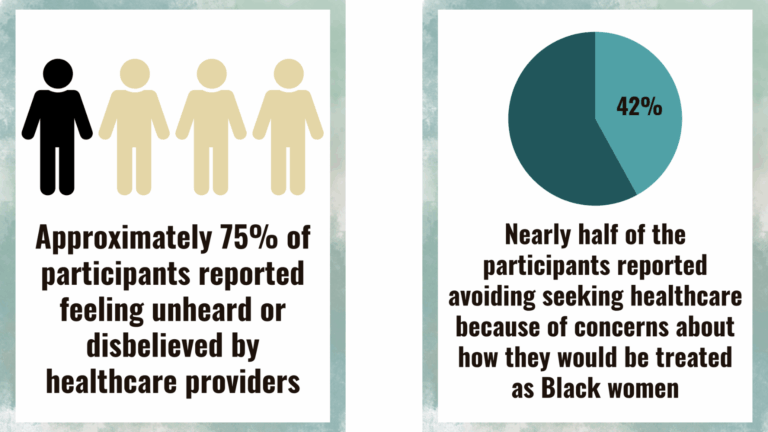
Voices Unheard fills this critical gap. Nearly two thousand people responded to the survey, which DM&C helped launch in the fall of 2024. As the report writers, editors and designers, we poured over the details to bring his critical research to light. The respondents shared stories of being misdiagnosed, ignored, disrespected, left to suffer, and told they were ‘too functional’ to receive mental health care. One of the Voices Unheard participants revealed: “You stop [seeking care] because it becomes exhausting to explain your entire self before anyone even tries to help you.”
“Black women, girls and gender non-conforming people responded because they were desperate to be heard. This report is our collective testimony and also serves as a warning: if systems do not change, if race-based and gender-based data is not collected, if institutions continue to pretend that anti-Black racism is not costing lives, more Black women will die." — Kearie Daniel, Founder and Executive Director of BWIH
Our role
Our collaboration with BWIH began with a clear goal: develop the report around the voices and experiences of the Black women and girls in this study.
“Managing a project like this meant constantly asking ourselves: are we centring the voices that matter most? Are we making their experiences impossible to ignore? This work wasn't simply about presenting statistics; it was about honouring the lived realities of nearly two thousand respondents who had the courage to share their stories. Every decision came back to that responsibility.” — Natassia Morris, Project Manager at DM&C
Our methodology brought together rigorous research, a compelling narrative and impactful design to ensure the report would serve as an enduring resource. From the inclusion of impactful quotes to the data visualizations, every aspect of this report was built with intention — to respect the gravity of the testimonials and make it impossible not to hear them.
"Data alone doesn't move people to action—storytelling does. Our work with BWIH was about taking critical research and presenting it in a way that honours Black women's experiences while creating an undeniable case for systemic change. When design, narrative and research come together, that's when information transforms into impact. Our hope is that this report becomes a turning point so that future generations of Black women and girls won't have to fight to be heard, seen or believed."
— Dayo Kefentse, Founder & Managing Director of DM&C
Our commitment to partnering with organizations fighting for systemic change is at the heart of what we do. Voices Unheard is more than a report — it’s a tool for advocacy that demands government policy changes and race-based data collection to address anti-Black racism in healthcare.